
ADVANCED RF SYSTEMS ENGINEERING
From RF modules to integrated subsystems.
AWG develops custom RF and microwave subsystems, transceivers, phased-array electronics and integrated RF systems for defence, aerospace, satellite communications, research and advanced R&D applications.
ENGINEERING CAPABILITIES
Advanced RF Systems, From Concept to Integration
AWG develops application-specific RF and microwave subsystems spanning signal generation, frequency conversion, amplification, filtering, switching, multi-channel reception and system-level integration.
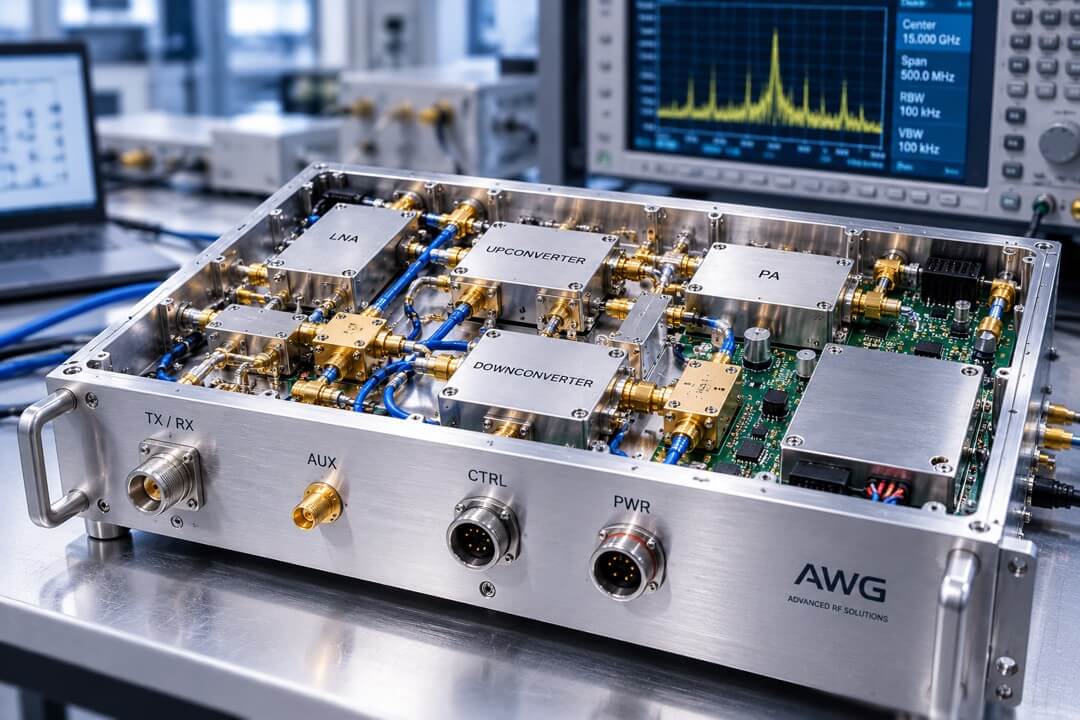
Custom Transceivers
Application-specific transmit and receive architectures integrating frequency conversion, filtering, gain control, switching and RF amplification.
EXPLORE CAPABILITY →
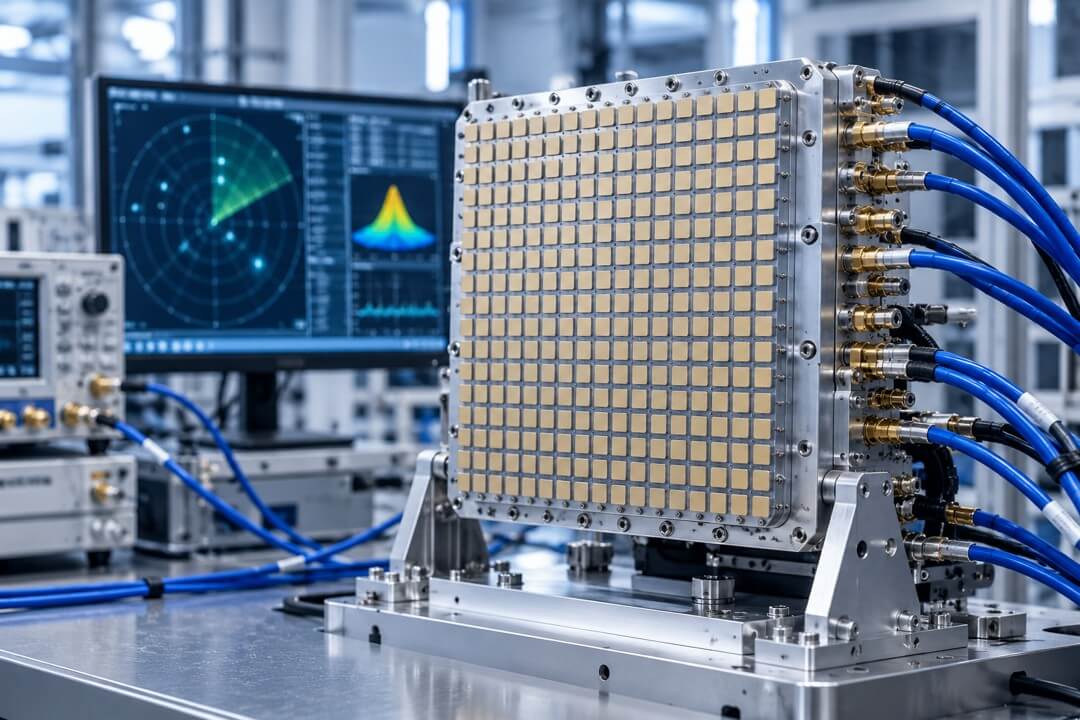
Phased Array & Multi-Channel RF
Multi-channel RF architectures, phased-array modules, beamforming subsystems and radar front ends for advanced sensing applications.
EXPLORE CAPABILITY →
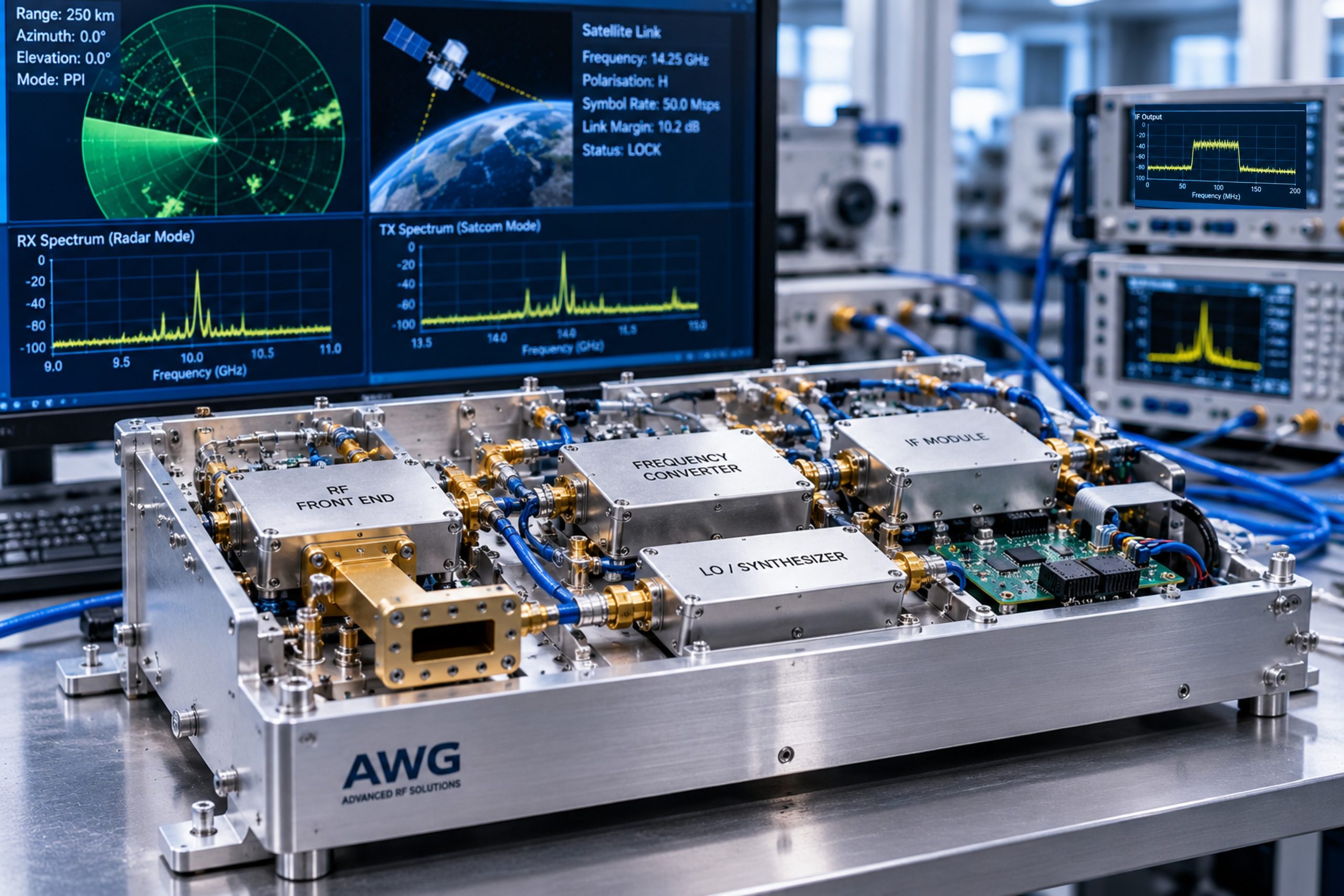
Radar & Satcom RF Systems
RF architectures and subsystems for radar, satellite communications and specialised sensing applications.
EXPLORE CAPABILITY →
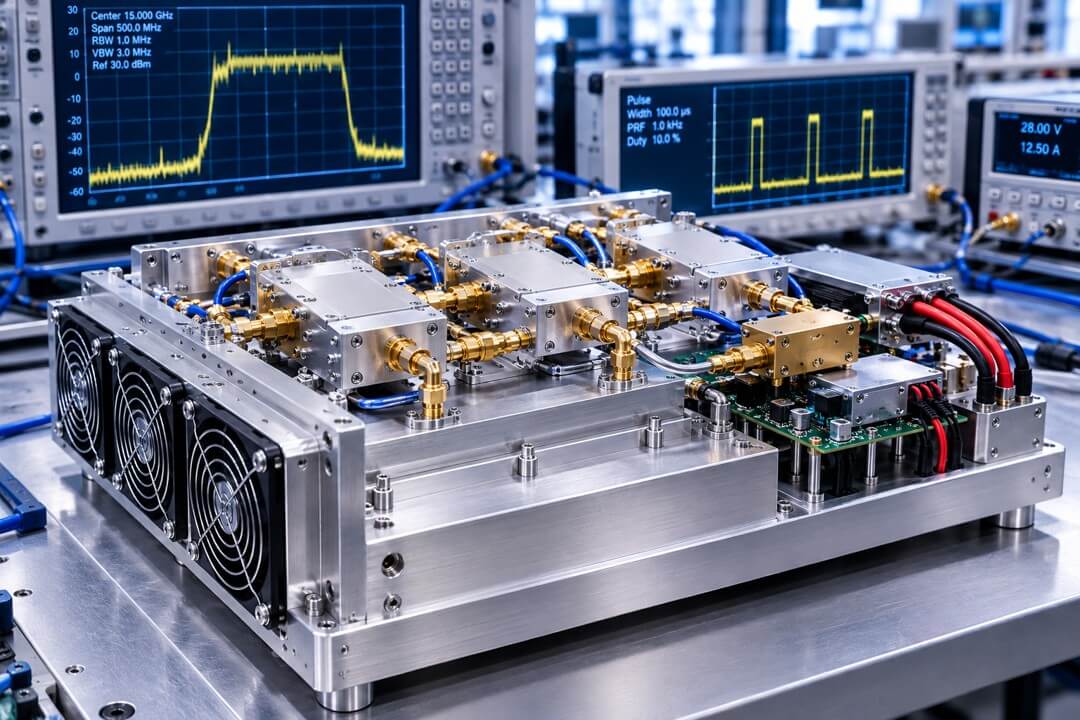
High-Power RF & Microwave
Power-amplifier integration, pulsed RF systems, protection, monitoring and thermal considerations.
EXPLORE CAPABILITY →
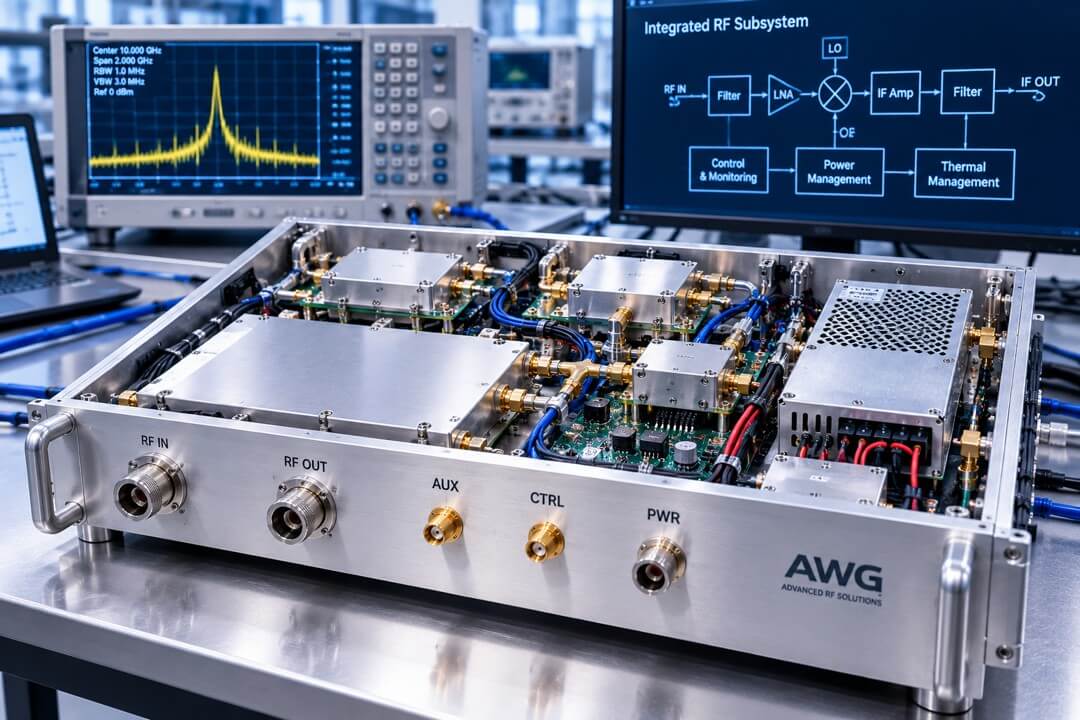
Integrated RF Subsystems
Multi-function RF assemblies integrating active and passive circuitry, control electronics and power management.
EXPLORE CAPABILITY →
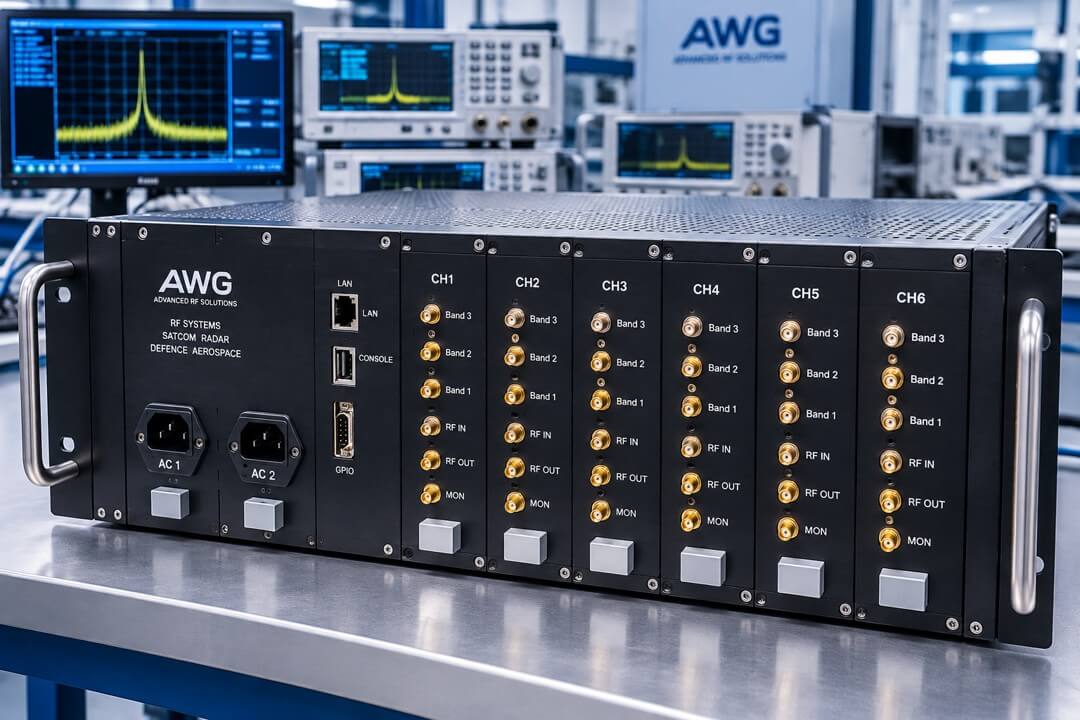
Rack-Mount RF Systems
19-inch integrated systems combining RF, digital control, power distribution, monitoring and external interfaces.
EXPLORE CAPABILITY →
SELECTED RF SYSTEMS
RF Systems Developed Around Real Programme Requirements
Field-proven RF subsystem design patterns for demanding airborne, shipboard, ground-mobile, and high-security installations.
Representative RF and microwave systems developed by AWG illustrate our approach to frequency conversion, coherent multi-channel reception, signal conditioning and high-power RF.
Each system is engineered around programme-specific electrical, mechanical, control and environmental requirements.
Standard modular catalogs cannot accommodate tightly constrained SWaP envelopes, intense pulsed thermal dissipation, and sub-degree channel coherence. AWG Tech bridges the gap between high-level RF architectures and qualified, field-deployable hardware.
DC - 40 GHz
Full In-House Development Lab
ITAR-FREE
Singapore Design
MIL-STD-810/461/704
Designed & Qualified
Customized Design
From RF/MW components to systems
01 - Wideband Microwave Downconverter Systems
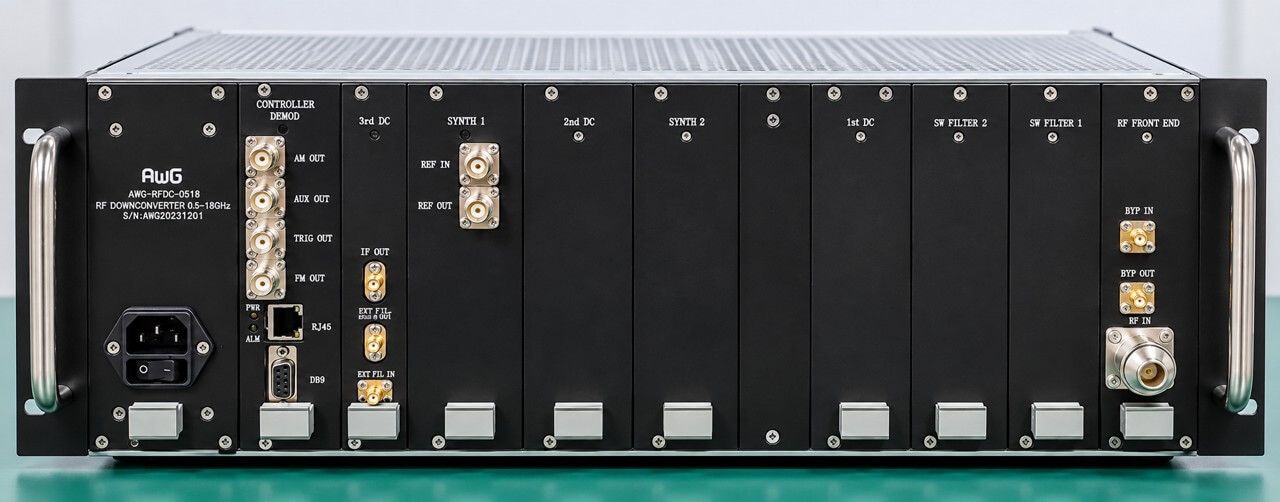
0.5 - 18 GHz RF Input Frequency
Automatic RF preselection • Selectable IF bandwidths • Low-phase-noise synthesis • Programmable gain • 1 Hz tuning resolution
Modular wideband frequency-conversion system integrating automatic front-end preselection, multi-stage conversion, selectable IF filtering and programmable gain control.
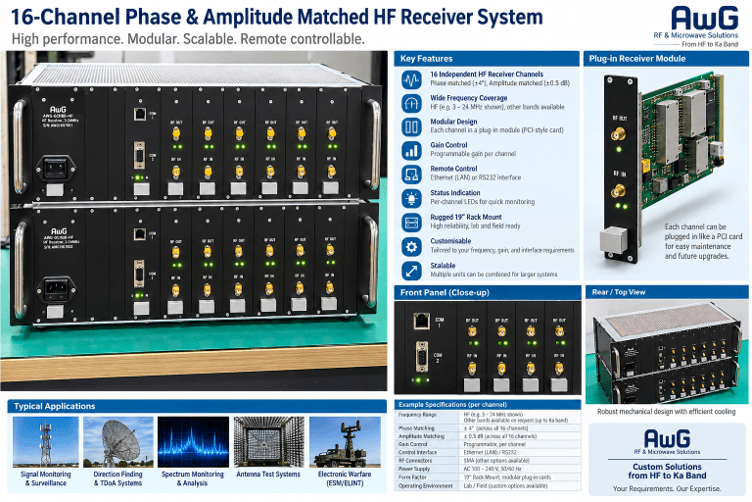
02 - Phase & Amplitude Matched HF Receiver System
Up to 16 Coherent Receiver Channels
±4° Phase Matching • ±0.5 dB Amplitude Matching • Programmable Gain • Ethernet/RS-232 Control
Modular multi-channel HF receiver architecture with individually removable receiver channels and selectable preselector bands.
- Frequency Range: HF-Band (2-30MHz)
03 - Configurable RF Signal Conditioning System
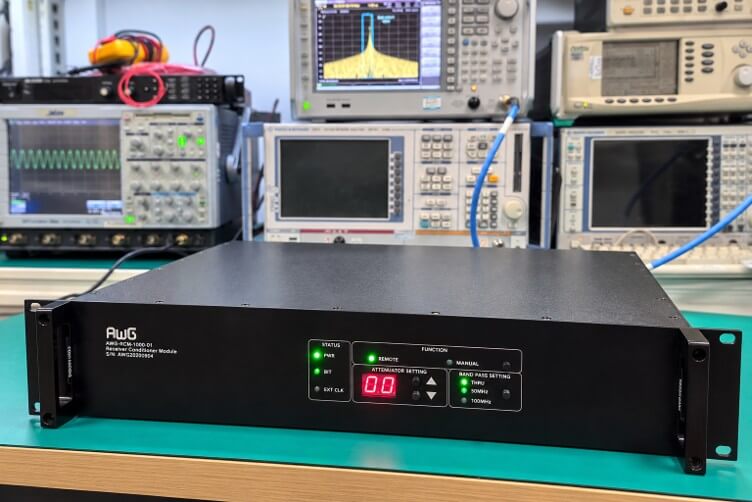
Custom Signal-Chain Integration
Limiters • LNAs / amplifiers • Step attenuators • Filters • Splitters • Couplers • Control
Application-specific RF conditioning platforms integrating protection, gain, filtering, attenuation and signal distribution within a single controlled subsystem.
04 - Ku-Band Pulsed Solid-State Power Amplifier
High-Power Pulse Mirowave Amplification
Ku-band • Pulsed operation • Monitoring • Control • Thermal management
Integrated solid-state power amplifier developed for high-power pulsed microwave applications with system-level control, monitoring and thermal considerations.
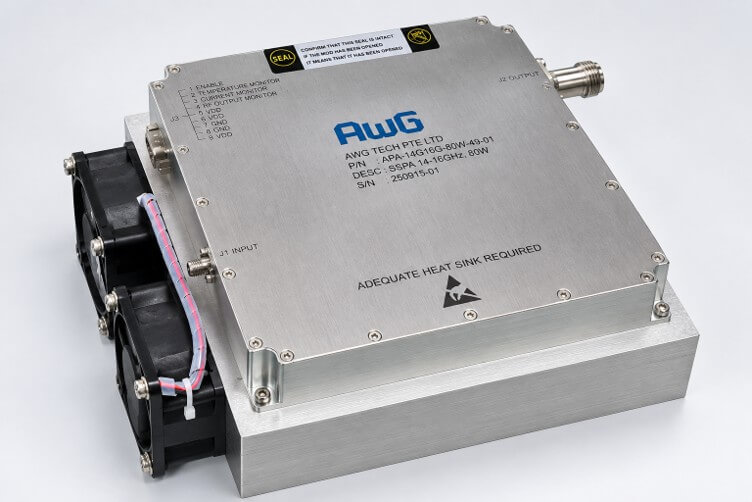
From RF Requirements to Integrated Hardware
AWG develops RF and microwave systems from application-level requirements through architecture, detailed RF design, subsystem integration and verification.
Our engineering approach considers the complete signal chain — including frequency planning, gain and noise budgets, filtering, spurious performance, linearity, isolation, switching, control, power distribution, thermal management and mechanical integration.
01
Requirements & Architecture
System requirements, frequency planning, interfaces and performance allocation.
02
RF Design & Simulation
Frequency conversion, gain and noise budgets, filtering, linearity, isolation and spurious analysis.
03
Hardware Development
RF circuitry, frequency synthesis, control electronics, power distribution and mechanical implementation.
04
System Integration
Subsystem integration, signal-chain optimisation, interfaces, thermal management and system-level control.
05
Verification & Qualification
RF performance verification, environmental considerations and test against programme requirements.
Engineering for Demanding RF Applications
AWG develops RF and microwave hardware for applications where signal integrity, spectral performance, isolation, power handling and system integration must be addressed at the complete-system level.
Defence & Radar Systems
Radar RF front ends, phased-array RF architectures, high-power transmit chains and specialised sensing systems.
Satellite Communications
Ku-band and microwave transceiver architectures, frequency conversion, filtering and RF signal distribution.
Aerospace & Mission Systems
Integrated RF hardware developed around demanding electrical, mechanical, thermal and environmental constraints.
Research & Advanced R&D
Custom RF platforms, experimental architectures and specialised instrumentation for research institutes, universities and technology development programmes.
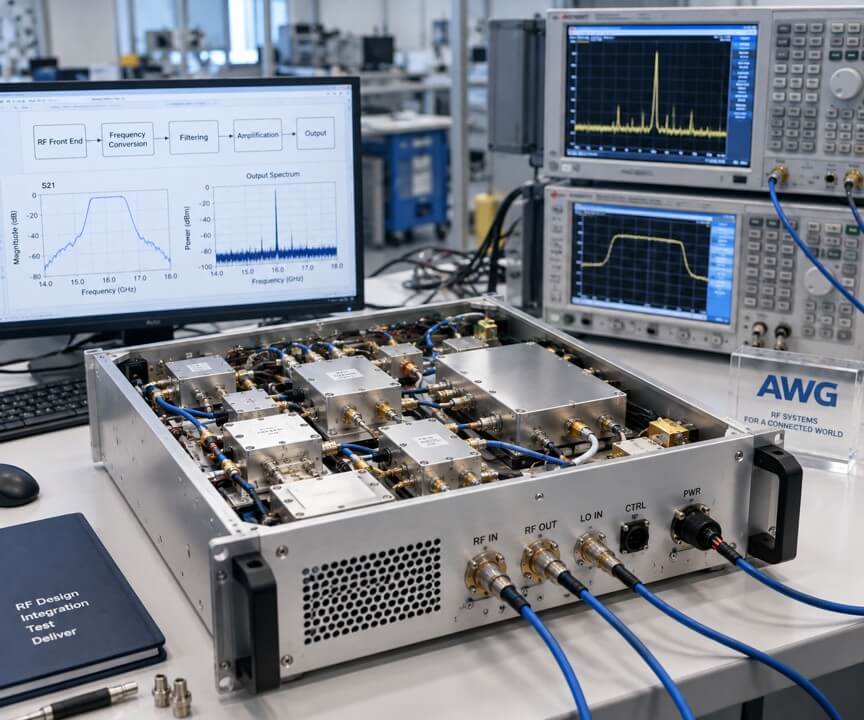
RF Components
AWG produces RF and microwave components such as filters, amplifiers, couplers, power dividers, RF switches, circulators, isolators and other RF components. More details are available on our dedicated RF component website, AWGRF
Two-Stage Receiver Cascaded NF & Gain Estimator
Evaluate how first-stage LNA performance dominates your RF front-end receiver chain using the Friis formula:
F_total = F1 + (F2 - 1) / G1
Stage 1 provides 18.0 dB of gain, which suppresses Stage 2's 20.0 dB noise factor. The overall receiver NF degrades by only +3.57 dB beyond the bare LNA front-end.
Discuss Your RF Requirements
Need help developing an RF subsystem, receiver, frequency converter, phased-array front end or specialised microwave assembly?
Talk to AWG about the electrical, mechanical and system requirements of your programme.
Send us your frequency plan, performance requirements, interfaces, SWaP constraints, or system block diagram. Our senior microwave engineering team in Singapore will review feasibility under mutual Non-Disclosure Agreement (NDA).
Send us an email at: sales@awg.com.sg